


Rutherford County Planning
Know the records, utility and permit route before work.
Murfreesboro Septic Services is the #1 septic in Murfreesboro, TN. We handle septic pumping, septic cleaning, septic inspections, tank repairs, septic installation or replacement, and drain field services for residential and commercial properties across greater Murfreesboro.
We have over 18 years of experience handling installation, oversight, and business development. It is important to start with the cause, then choose the right service for your property. Rutherford County soil, limestone, drainage and sewer access shape the plan. Expected service life depends on the installed product, site conditions and maintenance.
Know the records, utility and permit route before work.
Separate plumbing, tank, pump and field problems.
Know the work, access and starting price.
Compare pumping, repair and replacement in plain language.
Check usable soil, limestone, runoff and reserve area.
Keep records and care matched to the system.
Start with the service that matches your need. If you are unsure, describe the symptoms.

Routine care, a recurring backup or a new system: each starts with a clear scope and the property’s actual needs.
Remove accumulated solids and check accessible tank parts. Confirm capacity, access and the reason for service.
Explore Septic ServiceAddress stubborn deposits and accessible filters after defining the cleaning scope and tank condition.
Explore Septic ServiceReview tank condition and accessible equipment for maintenance or a real estate purchase. Define field assessment separately.
Explore Septic ServiceFind the failed filter, fitting, seal, cover or pump. Compare targeted repair with structural replacement.
Explore Septic ServicePlan capacity, treatment and the field together. Check sewer availability, usable soil and county approval first.
Explore Septic ServiceRequest help for backups or high tank levels. Report affected fixtures, alarms and wet-ground conditions.
Explore Septic Service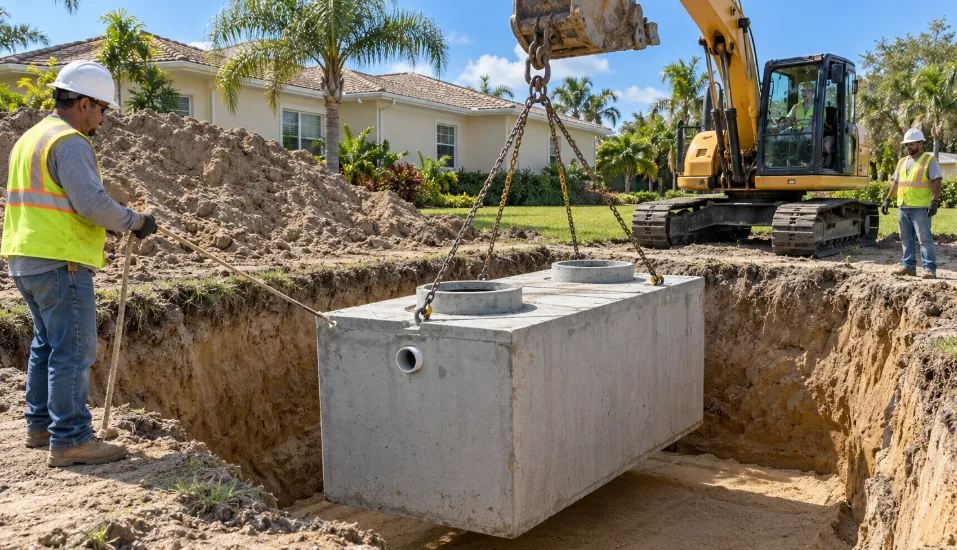
A tank can be sound while the field struggles. Review distribution, soil and groundwater before deciding on repair or replacement.
Separate broken lines and dosing faults from soil that cannot absorb flow. Repair the confirmed cause.
Explore Drain Field ServiceInvestigate recurring wet spots, odors and backups. Review the layout, distribution and changes to the site.
Explore Drain Field ServiceProtect usable soil and plan an approved replacement when repairs cannot restore reliable treatment.
Explore Drain Field ServiceStart with the floor plan, system record, sewer availability and site conditions before choosing a tank or replacement field.

The listing median describes Rutherford County, not every Murfreesboro home. Bedrooms set residential tank minimums; the installed tank and approved use must be checked from records.
Apply through TDEC before dirt work. Published general review is about 10 days, with up to 45 days after a complete application in current guidance. Soil work, design and final inspection add separate time. Confirm the current queue.
What looks like a tank failure can start in the drain field, the plumbing or the way the property uses water.
Missed pumping or a failed filter can clog the field.
Leaks and heavy use can exceed the design.
These block pipes and interfere with treatment.
Saturated ground reduces the field’s capacity.
Roots damage pipes; heavy loads compact soil or crush parts.
Neglected pumps and added bedrooms change performance.
A septic system is more than a tank. Its storage capacity, treatment process and drain field each do a different job. Use this guide to understand home size, tank materials, expected lifespan and Murfreesboro conditions before choosing a service.
2,217 sq ft was the September 2026 median listed-home size in Rutherford County. It is county market context, not a citywide average or a survey of septic-served homes.
A three-bedroom house around 2,200 sq ft is an example. Use bedrooms, approved occupancy and system records to size the tank; floor area alone does not set capacity.
| Bedrooms | Minimum tank capacity |
|---|---|
| 2 or fewer | 750 gallons |
| 3 | 900 gallons |
| 4 | 1,000 gallons |
| 5 | 1,250 gallons |
| 6 | 1,500 gallons |
These are state minimums, not a measured local tank average. Add 250 gallons per bedroom above four. Check the existing permit and approved design; the installed tank may be larger.
Tank gallons, daily sewage flow and drain field area are different measurements. Commercial systems require their own flow and wastewater review.
Heavy and durable. Check seams, cracks, lifting access and bedding.
Lighter to move. Correct support, backfill and groundwater protection matter.
Lightweight and corrosion-resistant. Use an approved model and installation method.
The tank shell, drain field and mechanical parts age differently. Installation, site conditions and maintenance affect life; no material guarantees a replacement age.
Suitable sites may use conventional trenches or approved graveless products. More difficult lots may need low-pressure pipe, a mound, or aerobic treatment with subsurface drip. Soil evaluation determines suitability.
CUD STEP is utility infrastructure. If a CUD STEP alarm sounds or service is needed, contact CUD at 615-893-7225 first. CUD owns its STEP equipment and maintains it through the sewer service fee.
For city-served properties, Murfreesboro Water Resources determines sewer availability. Confirm the serving utility before choosing replacement.
USGS documents limestone and sinkhole flooding around Murfreesboro. The usable soil depth, rock, drainage and replacement area matter more than simply buying a larger tank.
NOAA’s Murfreesboro 5 N station averages about 56 inches of rain a year under 1991–2020 normals. Saturated soil can limit field performance. Assess the parcel; these conditions vary by address.
Keep runoff, paving and heavy traffic off the field. Have pumping safety assessed after flooding or prolonged wet ground.
The TDEC Nashville Environmental Field Office serves Rutherford County. Call 615-687-7000 for the appropriate septic contact. This is the agency, not our service number.
TDEC publishes a general review estimate of 10 days. Its current FAQ says processing can take up to 45 days after a complete application. Confirm the current queue; soil mapping, design, corrections, construction and inspection add separate time.
Eligible third-party packages have a separate 10-business-day review route that can result in approval, deficiencies or a request for information. This is not an overall installation promise.
Posted government fees include $400 for a conventional permit up to 1,000 gpd plus $100 inspection; alternative permits start at $500 plus $200 inspection. The repair permit has no permit fee, with a $100 repair inspection fee. Higher flows and other services can add charges. Confirm current fees with TDEC.
Rutherford County building documents distinguish a TDEC septic permit from a CUD STEP permit. Pools, accessory buildings and bedroom additions may require records or modification approval. The county’s 24–48-hour building-permit estimate is not a septic review time.
Reviewed October 28, 2026. Current permits and agency requirements control.
Practical answers for Murfreesboro homes and businesses.
Rutherford County’s September 2026 listing median was 2,217 sq ft. It is not a citywide mean or a septic-home average.
No measured local installed-tank average was established. State minimum examples are 750 gallons through two bedrooms, 900 for three and 1,000 for four. Check the permit.
TDEC administers Rutherford County septic services through its online service request process and Nashville Environmental Field Office.
TDEC publishes a general 10-day review estimate. Current FAQ guidance allows up to 45 days after a complete application. Soil work, design and inspections add time; confirm the queue.
No. STEP serves a shared utility treatment system. CUD owns its STEP equipment and should be contacted first for alarms or service.
No. Usable soil, rock, drainage, slope and available area determine the approved system.
They can. Check TDEC records and modification requirements before changing bedrooms, grading or the approved tank and field areas.
Many private conventional households need pumping every three to five years. Occupancy, solids and tank size set the interval; coordinate STEP work with its utility.
No. Scope, availability and scheduling are confirmed separately.
Tell us where you are, what is happening and the service you need.